









HumanoidInsight
  • Home
  • Spotlight
    Why Are Robotics Companies Waging an All-Out Talent War Against Big Tech and Academia?

    Why Are Robotics Companies Waging an All-Out Talent War Against Big Tech and Academia?

    Can Humanoid Robots Truly Be Artists, Musicians, or Chefs, or Is Creativity Uniquely Human?

    Can Humanoid Robots Truly Be Artists, Musicians, or Chefs, or Is Creativity Uniquely Human?

    The “Spinal Cord” Chip: Neuromorphic Processors for Low-Power, Reflex-Level Control

    The “Spinal Cord” Chip: Neuromorphic Processors for Low-Power, Reflex-Level Control

    Startup Spotlight: Apptronik – Betting on a General-Purpose Upper Body for Multiple Applications

    Startup Spotlight: Apptronik – Betting on a General-Purpose Upper Body for Multiple Applications

    How Is a Neuroscientist Using Brain Science to Transform Robot Motor Control and Enable Fluid, Adaptive Movements?

    How Is a Neuroscientist Using Brain Science to Transform Robot Motor Control and Enable Fluid, Adaptive Movements?

    Interview: Boston Dynamics’ CEO on the Commercialization of Atlas and the Future of Parkour

    Interview: Boston Dynamics’ CEO on the Commercialization of Atlas and the Future of Parkour

  • Future Scenarios
    Why Are Humanoid Robots Becoming the Essential Workforce for Building Off-World Habitats?

    Why Are Humanoid Robots Becoming the Essential Workforce for Building Off-World Habitats?

    The Demographics Solution: Can Humanoids Solve the Crisis of Aging Populations?

    The Demographics Solution: Can Humanoids Solve the Crisis of Aging Populations?

    Is Universal Basic Income the Inevitable Solution to Widescale Robotic Automation?

    Is Universal Basic Income the Inevitable Solution to Widescale Robotic Automation?

    Analysis: Why Did Hyundai Double Down on Boston Dynamics? A Strategic Look Beyond Spot and Atlas

    Analysis: Why Did Hyundai Double Down on Boston Dynamics? A Strategic Look Beyond Spot and Atlas

    The Psychological Uncanny Valley: How Lifelike Robots Could Trigger Social Anxiety and Identity Crises

    The Psychological Uncanny Valley: How Lifelike Robots Could Trigger Social Anxiety and Identity Crises

    Who Should Be Held Responsible When a Humanoid Robot Causes Harm?

    Who Should Be Held Responsible When a Humanoid Robot Causes Harm?

  • Industry Pulse
    Title: Major Stumble: What the Failure of a High-Profile Humanoid Startup Teaches the Industry

    Title: Major Stumble: What the Failure of a High-Profile Humanoid Startup Teaches the Industry

    Why Are Robotics Companies Waging an All-Out Talent War Against Big Tech and Academia?

    Why Are Robotics Companies Waging an All-Out Talent War Against Big Tech and Academia?

    Will the “Robotics as a Service” Model Become the Dominant Path for Humanoid Deployment?

    Will the “Robotics as a Service” Model Become the Dominant Path for Humanoid Deployment?

    The Demographics Solution: Can Humanoids Solve the Crisis of Aging Populations?

    The Demographics Solution: Can Humanoids Solve the Crisis of Aging Populations?

    Analysis: Why Did Hyundai Double Down on Boston Dynamics? A Strategic Look Beyond Spot and Atlas

    Analysis: Why Did Hyundai Double Down on Boston Dynamics? A Strategic Look Beyond Spot and Atlas

    Who Should Be Held Responsible When a Humanoid Robot Causes Harm?

    Who Should Be Held Responsible When a Humanoid Robot Causes Harm?

  • Insight Reports
    Title: Major Stumble: What the Failure of a High-Profile Humanoid Startup Teaches the Industry

    Title: Major Stumble: What the Failure of a High-Profile Humanoid Startup Teaches the Industry

    Will the “Robotics as a Service” Model Become the Dominant Path for Humanoid Deployment?

    Will the “Robotics as a Service” Model Become the Dominant Path for Humanoid Deployment?

    Is Universal Basic Income the Inevitable Solution to Widescale Robotic Automation?

    Is Universal Basic Income the Inevitable Solution to Widescale Robotic Automation?

    The Psychological Uncanny Valley: How Lifelike Robots Could Trigger Social Anxiety and Identity Crises

    The Psychological Uncanny Valley: How Lifelike Robots Could Trigger Social Anxiety and Identity Crises

    The Environmental Payback: Modeling the Carbon Footprint Reduction of a Robot-Led Workforce

    The Environmental Payback: Modeling the Carbon Footprint Reduction of a Robot-Led Workforce

    How Are Photorealistic Simulation and Domain Randomization Closing the Gap Between Virtual and Real-World Humanoid Robotics?

    How Are Photorealistic Simulation and Domain Randomization Closing the Gap Between Virtual and Real-World Humanoid Robotics?

  • Tech Frontiers
    Why Are Humanoid Robots Becoming the Essential Workforce for Building Off-World Habitats?

    Why Are Humanoid Robots Becoming the Essential Workforce for Building Off-World Habitats?

    The End of the Frontline? Reimagining Military Strategy in an Era of Robot Soldiers

    The End of the Frontline? Reimagining Military Strategy in an Era of Robot Soldiers

    How Are Photorealistic Simulation and Domain Randomization Closing the Gap Between Virtual and Real-World Humanoid Robotics?

    How Are Photorealistic Simulation and Domain Randomization Closing the Gap Between Virtual and Real-World Humanoid Robotics?

    The “Spinal Cord” Chip: Neuromorphic Processors for Low-Power, Reflex-Level Control

    The “Spinal Cord” Chip: Neuromorphic Processors for Low-Power, Reflex-Level Control

    Are Fuel Cells the Future of Untethered, All-Day Humanoid Robot Operation, or Will Batteries Remain King?

    Are Fuel Cells the Future of Untethered, All-Day Humanoid Robot Operation, or Will Batteries Remain King?

    Beyond Reinforcement Learning: The Rise of Large Behavior Models (LBMs) for Robot Training

    Beyond Reinforcement Learning: The Rise of Large Behavior Models (LBMs) for Robot Training

HumanoidInsight
  • Home
  • Spotlight
    Why Are Robotics Companies Waging an All-Out Talent War Against Big Tech and Academia?

    Why Are Robotics Companies Waging an All-Out Talent War Against Big Tech and Academia?

    Can Humanoid Robots Truly Be Artists, Musicians, or Chefs, or Is Creativity Uniquely Human?

    Can Humanoid Robots Truly Be Artists, Musicians, or Chefs, or Is Creativity Uniquely Human?

    The “Spinal Cord” Chip: Neuromorphic Processors for Low-Power, Reflex-Level Control

    The “Spinal Cord” Chip: Neuromorphic Processors for Low-Power, Reflex-Level Control

    Startup Spotlight: Apptronik – Betting on a General-Purpose Upper Body for Multiple Applications

    Startup Spotlight: Apptronik – Betting on a General-Purpose Upper Body for Multiple Applications

    How Is a Neuroscientist Using Brain Science to Transform Robot Motor Control and Enable Fluid, Adaptive Movements?

    How Is a Neuroscientist Using Brain Science to Transform Robot Motor Control and Enable Fluid, Adaptive Movements?

    Interview: Boston Dynamics’ CEO on the Commercialization of Atlas and the Future of Parkour

    Interview: Boston Dynamics’ CEO on the Commercialization of Atlas and the Future of Parkour

  • Future Scenarios
    Why Are Humanoid Robots Becoming the Essential Workforce for Building Off-World Habitats?

    Why Are Humanoid Robots Becoming the Essential Workforce for Building Off-World Habitats?

    The Demographics Solution: Can Humanoids Solve the Crisis of Aging Populations?

    The Demographics Solution: Can Humanoids Solve the Crisis of Aging Populations?

    Is Universal Basic Income the Inevitable Solution to Widescale Robotic Automation?

    Is Universal Basic Income the Inevitable Solution to Widescale Robotic Automation?

    Analysis: Why Did Hyundai Double Down on Boston Dynamics? A Strategic Look Beyond Spot and Atlas

    Analysis: Why Did Hyundai Double Down on Boston Dynamics? A Strategic Look Beyond Spot and Atlas

    The Psychological Uncanny Valley: How Lifelike Robots Could Trigger Social Anxiety and Identity Crises

    The Psychological Uncanny Valley: How Lifelike Robots Could Trigger Social Anxiety and Identity Crises

    Who Should Be Held Responsible When a Humanoid Robot Causes Harm?

    Who Should Be Held Responsible When a Humanoid Robot Causes Harm?

  • Industry Pulse
    Title: Major Stumble: What the Failure of a High-Profile Humanoid Startup Teaches the Industry

    Title: Major Stumble: What the Failure of a High-Profile Humanoid Startup Teaches the Industry

    Why Are Robotics Companies Waging an All-Out Talent War Against Big Tech and Academia?

    Why Are Robotics Companies Waging an All-Out Talent War Against Big Tech and Academia?

    Will the “Robotics as a Service” Model Become the Dominant Path for Humanoid Deployment?

    Will the “Robotics as a Service” Model Become the Dominant Path for Humanoid Deployment?

    The Demographics Solution: Can Humanoids Solve the Crisis of Aging Populations?

    The Demographics Solution: Can Humanoids Solve the Crisis of Aging Populations?

    Analysis: Why Did Hyundai Double Down on Boston Dynamics? A Strategic Look Beyond Spot and Atlas

    Analysis: Why Did Hyundai Double Down on Boston Dynamics? A Strategic Look Beyond Spot and Atlas

    Who Should Be Held Responsible When a Humanoid Robot Causes Harm?

    Who Should Be Held Responsible When a Humanoid Robot Causes Harm?

  • Insight Reports
    Title: Major Stumble: What the Failure of a High-Profile Humanoid Startup Teaches the Industry

    Title: Major Stumble: What the Failure of a High-Profile Humanoid Startup Teaches the Industry

    Will the “Robotics as a Service” Model Become the Dominant Path for Humanoid Deployment?

    Will the “Robotics as a Service” Model Become the Dominant Path for Humanoid Deployment?

    Is Universal Basic Income the Inevitable Solution to Widescale Robotic Automation?

    Is Universal Basic Income the Inevitable Solution to Widescale Robotic Automation?

    The Psychological Uncanny Valley: How Lifelike Robots Could Trigger Social Anxiety and Identity Crises

    The Psychological Uncanny Valley: How Lifelike Robots Could Trigger Social Anxiety and Identity Crises

    The Environmental Payback: Modeling the Carbon Footprint Reduction of a Robot-Led Workforce

    The Environmental Payback: Modeling the Carbon Footprint Reduction of a Robot-Led Workforce

    How Are Photorealistic Simulation and Domain Randomization Closing the Gap Between Virtual and Real-World Humanoid Robotics?

    How Are Photorealistic Simulation and Domain Randomization Closing the Gap Between Virtual and Real-World Humanoid Robotics?

  • Tech Frontiers
    Why Are Humanoid Robots Becoming the Essential Workforce for Building Off-World Habitats?

    Why Are Humanoid Robots Becoming the Essential Workforce for Building Off-World Habitats?

    The End of the Frontline? Reimagining Military Strategy in an Era of Robot Soldiers

    The End of the Frontline? Reimagining Military Strategy in an Era of Robot Soldiers

    How Are Photorealistic Simulation and Domain Randomization Closing the Gap Between Virtual and Real-World Humanoid Robotics?

    How Are Photorealistic Simulation and Domain Randomization Closing the Gap Between Virtual and Real-World Humanoid Robotics?

    The “Spinal Cord” Chip: Neuromorphic Processors for Low-Power, Reflex-Level Control

    The “Spinal Cord” Chip: Neuromorphic Processors for Low-Power, Reflex-Level Control

    Are Fuel Cells the Future of Untethered, All-Day Humanoid Robot Operation, or Will Batteries Remain King?

    Are Fuel Cells the Future of Untethered, All-Day Humanoid Robot Operation, or Will Batteries Remain King?

    Beyond Reinforcement Learning: The Rise of Large Behavior Models (LBMs) for Robot Training

    Beyond Reinforcement Learning: The Rise of Large Behavior Models (LBMs) for Robot Training

HumanoidInsight
No Result
View All Result
Home Spotlight

Can Real-Time AI Translation Break Language Barriers?

October 31, 2025
in Spotlight, Tech Frontiers
Can Real-Time AI Translation Break Language Barriers?

In a world more interconnected than ever, language remains both our greatest connector and our most persistent divider. Despite globalization’s promise of unity, miscommunication still fractures diplomacy, business, and even daily life. Now, with the rise of real-time AI translation—particularly through humanoid robots—the ancient walls of language may finally begin to crumble.

Imagine a humanoid interpreter who can instantly translate your words, capture your tone, and even mirror your emotional nuance in another language—all while standing beside you in physical form. From corporate boardrooms in Tokyo to classrooms in Nairobi, the dream of borderless communication is no longer science fiction. But can AI truly deliver perfect understanding? Or will cultural context and human subtlety keep the gap open?

This article examines the evolution of speech-to-speech automation in humanoids, explores the technological breakthroughs making it possible, profiles industry leader SoftBank Robotics, and forecasts how these innovations might transform global collaboration—and the very nature of communication itself.


Speech-to-Speech Automation in Humanoids

The ambition behind real-time translation has always been clear: to make human communication seamless, natural, and universal. For humanoid robots, this challenge extends far beyond mere word conversion—it involves emotionally intelligent speech modeling and contextual awareness.

Traditional translation software (like Google Translate or DeepL) processes text, but humanoids operate in live, spoken interaction, requiring layered processing across three domains:

  1. Speech Recognition – Converting audio to text via automatic speech recognition (ASR) models.
  2. Language Translation – Interpreting meaning through neural machine translation (NMT), powered by deep learning.
  3. Speech Synthesis – Reproducing speech in the target language with natural voice tonality and rhythm.

In humanoid robotics, these steps must occur within milliseconds to sustain natural conversation flow. Early systems like SoftBank’s Pepper, Honda’s ASIMO, and NTT’s communication robots faced latency and accuracy limitations—speech lagged behind, idioms were mistranslated, and emotional tone was lost.

However, new architectures such as Transformer-based neural networks, self-supervised language models, and context-aware acoustic embeddings have dramatically improved translation fidelity. Today, humanoids can not only translate spoken words but also detect sarcasm, humor, and sentiment, enabling subtler and more humanlike responses.

In essence, the goal has evolved from translating what people say to translating what they mean.


Key Research Breakthroughs

The field of AI-driven translation has accelerated due to several key breakthroughs that integrate linguistics, deep learning, and robotics engineering.

1. Neural Machine Translation (NMT) Revolution

In the 2010s, machine translation shifted from rule-based systems to NMT, where sequence-to-sequence neural networks learned from millions of bilingual text pairs. But the true revolution came with Transformer models, introduced by Google in 2017. Transformers allowed models to consider entire sentence context, improving accuracy for complex, idiomatic speech.

Modern translation engines—such as OpenAI’s Whisper, Meta’s SeamlessM4T, and Google’s Translatotron 3—can now perform end-to-end speech translation without intermediate text conversion. This architecture drastically reduces latency, a critical improvement for humanoid robots engaged in real conversation.

2. Multimodal AI Integration

Speech translation in humanoids now leverages multimodal AI, combining audio, visual, and textual cues. A robot observing facial expressions, gestures, or emotional tone can adjust translations accordingly.

For instance, if a speaker says “That’s great” sarcastically, a purely linguistic model might misinterpret it as positive. A multimodal model recognizes the facial cues and modifies translation tone appropriately.

This cross-sensory intelligence marks a major leap toward context-aware communication—a prerequisite for humanoids working in customer service, healthcare, and diplomacy.

3. Self-Learning Through Interaction

Leading humanoid platforms now use reinforcement learning and human feedback loops to improve translation accuracy dynamically. Robots in multilingual environments continuously refine their models by comparing user reactions and corrections, effectively “learning” cultural nuance through lived interaction.

Projects like Facebook AI’s No Language Left Behind (NLLB) and OpenAI’s cross-lingual reinforcement frameworks have further pushed inclusion, expanding translation to hundreds of low-resource languages once ignored by mainstream systems.

The result? A gradual democratization of global communication, powered not by human translators but by self-evolving, polyglot machines.


Company Spotlight: SoftBank Robotics

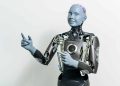
Among the companies pioneering real-time AI translation in humanoids, SoftBank Robotics stands as a global leader. Its flagship creation, Pepper, launched in 2014, was one of the first humanoid robots designed specifically for emotional interaction and cross-cultural communication.

Pepper: The Conversational Bridge

Pepper integrates multilingual AI powered by IBM Watson and later Google Cloud Speech-to-Text, enabling real-time translation across more than 15 languages. It recognizes speech patterns, detects emotions, and responds through both voice and expressive gestures.

Pepper has been deployed in airports, banks, hotels, and hospitals around the world. In Japan’s Narita Airport, Pepper helps international travelers navigate customs by switching seamlessly between Japanese, English, and Chinese. In Europe, it serves as a language-learning assistant, helping students practice pronunciation and comprehension.

SoftBank’s engineers emphasize not just linguistic fluency, but cultural empathy. Pepper’s gestures, pauses, and tone are localized for each region—bowing slightly in Japan, using hand gestures in Italy, and maintaining eye contact in the U.S. This adaptability makes its communication more organic than that of any previous robot.

Nao and Beyond

Beyond Pepper, SoftBank’s smaller humanoid Nao has become a research platform for AI translation and human–robot interaction. Universities worldwide use Nao to test models that combine speech recognition with emotional context mapping, creating responses that “feel” culturally authentic.

SoftBank’s recent collaboration with DeepL and Google DeepMind signals a next phase: integrating cutting-edge translation models directly into humanoid operating systems, allowing robots to act as instant interpreters between humans without relying on cloud latency.

The company envisions a future where robots like Pepper serve as linguistic diplomats—bridging not only languages but social gaps in global teamwork, education, and care.


Impact on Global Collaboration

Real-time translation humanoids could radically transform the global labor and communication landscape. From business to healthcare, the implications are profound.

1. International Business

Imagine a team meeting where participants from Tokyo, Berlin, and São Paulo converse naturally—each speaking their native language while humanoid translators ensure instant, accurate dialogue. This eliminates the need for human interpreters, accelerates negotiation cycles, and fosters deeper interpersonal connection.

Startups and multinationals alike are already experimenting with AI interpreter robots for hybrid conferences, allowing participants to “speak as they think”—an ability often lost in multilingual settings.

2. Education and Research

In education, humanoid translators could revolutionize access to global knowledge. Students in non-English-speaking regions could interact directly with professors and peers worldwide. AI-powered humanoids can also help teach pronunciation, accent comprehension, and cultural idioms with real-time feedback—bridging not only linguistic but pedagogical divides.

3. Healthcare and Humanitarian Aid

In hospitals and disaster zones, where language barriers can cost lives, humanoid interpreters are emerging as invaluable assets. Robots equipped with multilingual models can help doctors communicate with patients instantly—especially in regions lacking trained interpreters.

Organizations like Médecins Sans Frontières (MSF) and WHO are exploring AI translation tools for field use, where even basic translation between local dialects and medical English can determine treatment success.

4. Cultural Diplomacy

Diplomatic and cultural exchanges often hinge on subtle linguistic and emotional understanding. Humanoids capable of empathetic translation may soon act as neutral mediators, ensuring clarity in sensitive negotiations or peace talks.

However, this shift raises critical ethical questions: who controls the translation models? Whose linguistic biases are embedded in their training? As translation becomes automated, linguistic sovereignty itself could become a geopolitical issue.


Forecast: Borderless Communication Through Machines

As real-time AI translation matures, we edge closer to a world where language ceases to divide humanity. But the path forward will require balancing technological optimism with social caution.

The Promise

By 2030, experts predict that humanoid translators will be capable of neural-context understanding—analyzing not just words but also situational meaning, emotional subtext, and personal communication style. In this scenario, machines become true communication partners, capable of bridging linguistic gaps across continents.

For global enterprises, this means near-frictionless collaboration. For developing nations, it means inclusion in the global knowledge economy without the linguistic gatekeeping of English. For individuals, it could mean cultural proximity without travel—a shared human dialogue spanning accents, dialects, and traditions.

The Challenge

Yet, achieving true universality remains complex. Language carries not only grammar but history, identity, and emotion. No algorithm can fully grasp the poetic ambiguity or cultural resonance of human speech. The risk is that in pursuing perfect translation, we might flatten linguistic diversity into standardized meaning.

Thus, the real challenge isn’t whether AI can translate—but whether it can do so without erasing what makes each language unique.

The future will depend on ethical design: systems that translate with respect, nuance, and humility. Only then can humanoid interpreters fulfill their highest purpose—not to homogenize humanity, but to help us hear one another more clearly.

Tags: AI translationhumanoid roboticsPepper robotSoftBank Robotics
ShareTweetShare

Related Posts

Why Are Robotics Companies Waging an All-Out Talent War Against Big Tech and Academia?
Industry Pulse

Why Are Robotics Companies Waging an All-Out Talent War Against Big Tech and Academia?

December 15, 2025
Why Are Humanoid Robots Becoming the Essential Workforce for Building Off-World Habitats?
Future Scenarios

Why Are Humanoid Robots Becoming the Essential Workforce for Building Off-World Habitats?

December 14, 2025
Can Humanoid Robots Truly Be Artists, Musicians, or Chefs, or Is Creativity Uniquely Human?
Future Scenarios

Can Humanoid Robots Truly Be Artists, Musicians, or Chefs, or Is Creativity Uniquely Human?

November 30, 2025
The End of the Frontline? Reimagining Military Strategy in an Era of Robot Soldiers
Future Scenarios

The End of the Frontline? Reimagining Military Strategy in an Era of Robot Soldiers

November 30, 2025
How Are Photorealistic Simulation and Domain Randomization Closing the Gap Between Virtual and Real-World Humanoid Robotics?
Insight Reports

How Are Photorealistic Simulation and Domain Randomization Closing the Gap Between Virtual and Real-World Humanoid Robotics?

November 30, 2025
The “Spinal Cord” Chip: Neuromorphic Processors for Low-Power, Reflex-Level Control
Spotlight

The “Spinal Cord” Chip: Neuromorphic Processors for Low-Power, Reflex-Level Control

November 30, 2025
Leave Comment
  • Trending
  • Comments
  • Latest
Will Humanoid Robots Become Legal Citizens by 2050? Exploring Rights, Responsibilities, and the Future of Robotic Personhood

Will Humanoid Robots Become Legal Citizens by 2050? Exploring Rights, Responsibilities, and the Future of Robotic Personhood

October 13, 2025
Will Humans and Robots Coexist Seamlessly in 2040’s Smart Cities? Exploring the Rise of Symbiotic Urban Ecosystems

Will Humans and Robots Coexist Seamlessly in 2040’s Smart Cities? Exploring the Rise of Symbiotic Urban Ecosystems

October 13, 2025
Analysis: Why Did Hyundai Double Down on Boston Dynamics? A Strategic Look Beyond Spot and Atlas

Analysis: Why Did Hyundai Double Down on Boston Dynamics? A Strategic Look Beyond Spot and Atlas

December 12, 2025
The End of the Frontline? Reimagining Military Strategy in an Era of Robot Soldiers

The End of the Frontline? Reimagining Military Strategy in an Era of Robot Soldiers

November 30, 2025
Will Humanoid Robots Become Legal Citizens by 2050? Exploring Rights, Responsibilities, and the Future of Robotic Personhood

Will Humanoid Robots Become Legal Citizens by 2050? Exploring Rights, Responsibilities, and the Future of Robotic Personhood

A World Where Robots Are Teachers: Educational Ecosystem with Humanoids

A World Where Robots Are Teachers: Educational Ecosystem with Humanoids

Can Humanoid Robots Redefine Disaster Response? Exploring the Future of Rescue Robotics in Extreme Environments

Can Humanoid Robots Redefine Disaster Response? Exploring the Future of Rescue Robotics in Extreme Environments

The Great Robot Economy: Humanoids as Workers in All Sectors

The Great Robot Economy: Humanoids as Workers in All Sectors

Title: Major Stumble: What the Failure of a High-Profile Humanoid Startup Teaches the Industry

Title: Major Stumble: What the Failure of a High-Profile Humanoid Startup Teaches the Industry

December 15, 2025
Why Are Robotics Companies Waging an All-Out Talent War Against Big Tech and Academia?

Why Are Robotics Companies Waging an All-Out Talent War Against Big Tech and Academia?

December 15, 2025
Will the “Robotics as a Service” Model Become the Dominant Path for Humanoid Deployment?

Will the “Robotics as a Service” Model Become the Dominant Path for Humanoid Deployment?

December 14, 2025
Why Are Humanoid Robots Becoming the Essential Workforce for Building Off-World Habitats?

Why Are Humanoid Robots Becoming the Essential Workforce for Building Off-World Habitats?

December 14, 2025
HumanoidInsight

We provide a clear lens on the rapidly evolving world of humanoid robots through news interpretation, trend observation, and data-driven reports. Join our community to stay authoritatively informed about the next wave of automation and intelligence.

© 2025 humanoidinsight.com. contacts:[email protected]

No Result
View All Result
  • Home
  • Spotlight
  • Future Scenarios
  • Industry Pulse
  • Insight Reports
  • Tech Frontiers

© 2025 humanoidinsight.com. contacts:[email protected]

Welcome Back!

Login to your account below

Forgotten Password?

Retrieve your password

Please enter your username or email address to reset your password.

Log In