









The prospect of settling beyond Earth has shifted from science fiction to strategic planning. Government agencies, private aerospace companies, and research institutions now align around a shared understanding: any future where humans live on Mars, the Moon, or deep-space stations must begin with robots doing the work humans cannot yet safely do. Among the many robotic platforms proposed, humanoids have unexpectedly emerged as the most compelling candidates for constructing off-world habitats.
This article examines why this form factor is being prioritized, what technological barriers remain, and how iconic systems like NASA’s Valkyrie are shaping the era of extraterrestrial infrastructure building.
Introduction: Why Robots Must Build the First Homes on Mars
Before the first astronaut ever steps onto Martian soil ready to inhabit a base, a considerable amount of groundwork must already be complete. Landing pads must be stabilized. Power systems must be installed. Airlocks, radiation shelters, and life-support modules must be assembled, tested, and sealed. These tasks are not merely hazardous—they are logistically incompatible with human presence until much of the environment has been engineered to be habitable.
Radiation levels on Mars are 40–60 times higher than on Earth. Temperatures swing from 20°C to –130°C. Dust storms can engulf the planet for weeks. Add the roughly 20-minute communication delay between Earth and Mars, and it is clear that early construction cannot depend on continuous human teleoperation.
Robots, therefore, are the vanguard. And while many people imagine rover-type machines or industrial robotic arms, the habitats being designed for human occupants require interactions with human-designed tools, human-scaled interfaces, and human-sized infrastructure. This is where humanoid robots—once considered too unstable or inefficient—suddenly become not just relevant, but essential.
The Ideal Platform: Why Humanoid Form Factors Make Sense for Off-World Construction
A humanoid robot is not the most efficient design for every task. Wheeled and quadruped systems offer better stability on uneven terrain. Manipulator arms are unbeatable for fixed industrial processes. Yet for constructing human environments on alien soil, humanoids offer three decisive advantages.
1. Compatibility with Human Tools and Architecture
Early Mars or lunar bases are engineered using components that assume human ergonomics:
- tool grips sized for human hands
- hatch mechanisms designed for human reach
- control panels built for eye-level interfaces
- modular structures assembled using human-patterned movements
Humanoid robots can step into these workflows without requiring a complete redesign of hardware.
2. Versatility in Unstructured Environments
A construction site—especially one on another planet—is unpredictable. From climbing over uneven regolith to entering tight modules, humanoids have:
- bipedal locomotion for navigating human-scaled spaces
- articulated arms for multi-step manipulation
- the ability to carry, lift, brace, torque, and align components
The flexibility to switch rapidly between tasks dramatically reduces mission complexity.
3. Future Human–Robot Coexistence
Once astronauts land, coexistence with robots becomes essential. A shared form factor allows both parties to use the same spaces, tools, and interfaces with minimal adaptation. Robots can assist with:
- heavy lifting
- inspection
- maintenance
- external repairs
The humanoid form ensures a seamless partnership.
Technical Challenges: What Must Be Solved Before Humanoid Robots Thrive Off-World?
Despite their promise, humanoids face a formidable technical gauntlet before being deployed in extraterrestrial construction.
1. Radiation Hardening
Cosmic rays, charged particles, and solar storms can:
- corrupt memory
- degrade sensors
- fry electronics
Radiation-hardened chips are essential yet currently provide lower performance compared to standard processors. Humanoids need robust shielding, fault-tolerant architectures, and self-diagnostic systems capable of isolating and bypassing failures.
2. Extreme Temperature Operation
Martian and lunar environments can reach temperatures that disable:
- lithium batteries
- hydraulic actuators
- rubberized joint seals
- optical cameras
Research is ongoing into:
- solid-state batteries
- cryo-resistant lubricants
- heat-regulated joint assemblies
- multi-spectral vision systems
Without these adaptations, robotics systems cannot survive long-duration missions.
3. Autonomous Repair and Maintenance
Robots several million miles away cannot return to a service center. They must:
- diagnose degradation
- replace modules
- recalibrate sensors
- self-repair minor damage
This requires a leap in robotic self-maintenance capabilities, something closer to robotic self-sufficiency than anything deployed today.
4. High-Level Autonomy
Due to communication delays, humanoids must:
- interpret ambiguous construction environments
- plan multi-step tasks
- detect hazards
- handle unexpected variations
Advances in reinforcement learning, large-scale simulation training, and onboard decision-making are enabling increasingly robust autonomy.
Profile: NASA’s Valkyrie—A Glimpse at the Future of Space Construction
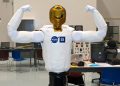
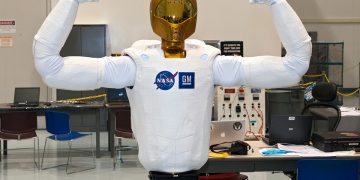
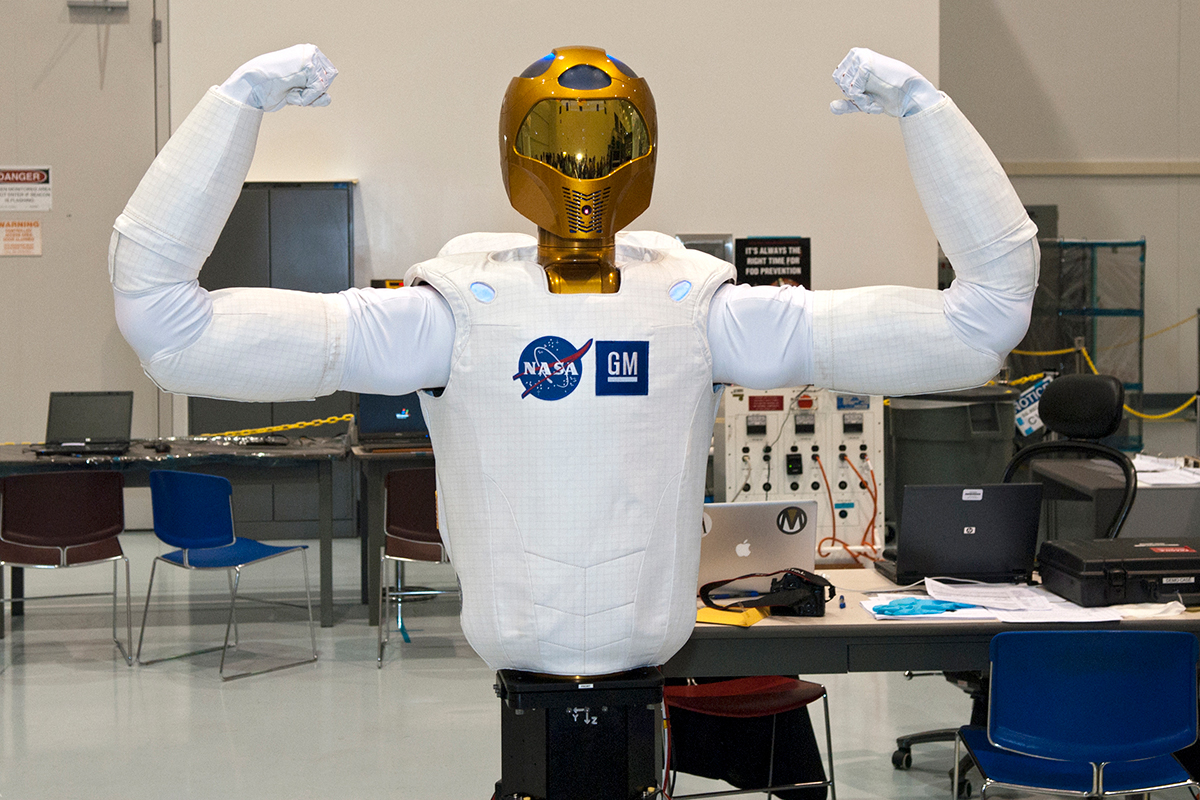
NASA’s R5 “Valkyrie” humanoid robot remains one of the most advanced attempts to create a machine purpose-built for extreme environments.
Origins and Goals
Initially designed for disaster response, Valkyrie evolved into a platform for off-world operations. NASA’s long-term objective is to prepare robots capable of:
- habitat assembly
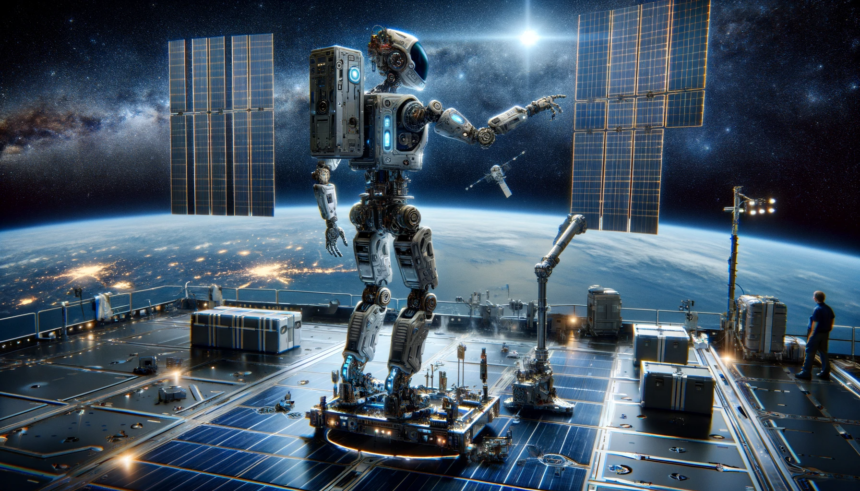
- solar array deployment
- maintenance of remote facilities
- precursor scouting for human missions
Key Technical Features
- Torque-controlled actuators for precise, adaptive movements
- High-bandwidth sensor fusion enabling real-time environment modeling
- Modular joints for rapid field repair
- Human-scaled articulation allowing it to use standard tools
The robot is currently part of collaborative testing with top research universities focused on autonomy, multi-contact locomotion, and dexterous manipulation.
Why Valkyrie Matters
Valkyrie represents more than a robot—it represents a strategy. NASA’s researchers envision a future where:
- entire construction teams of humanoids
- operate on the Moon and Mars decades ahead of humans
- building habitats, power grids, and protective structures
Valkyrie is the prototype for that workforce.
Call to Action: Watch Our Documentary on the History of Robots in Space
From Apollo-era manipulator arms to modern planetary rovers and now next-generation humanoids, space robotics has undergone a profound transformation. To explore this evolution and the future workforce of space construction, watch our exclusive documentary on the history and trajectory of robots in space exploration.