





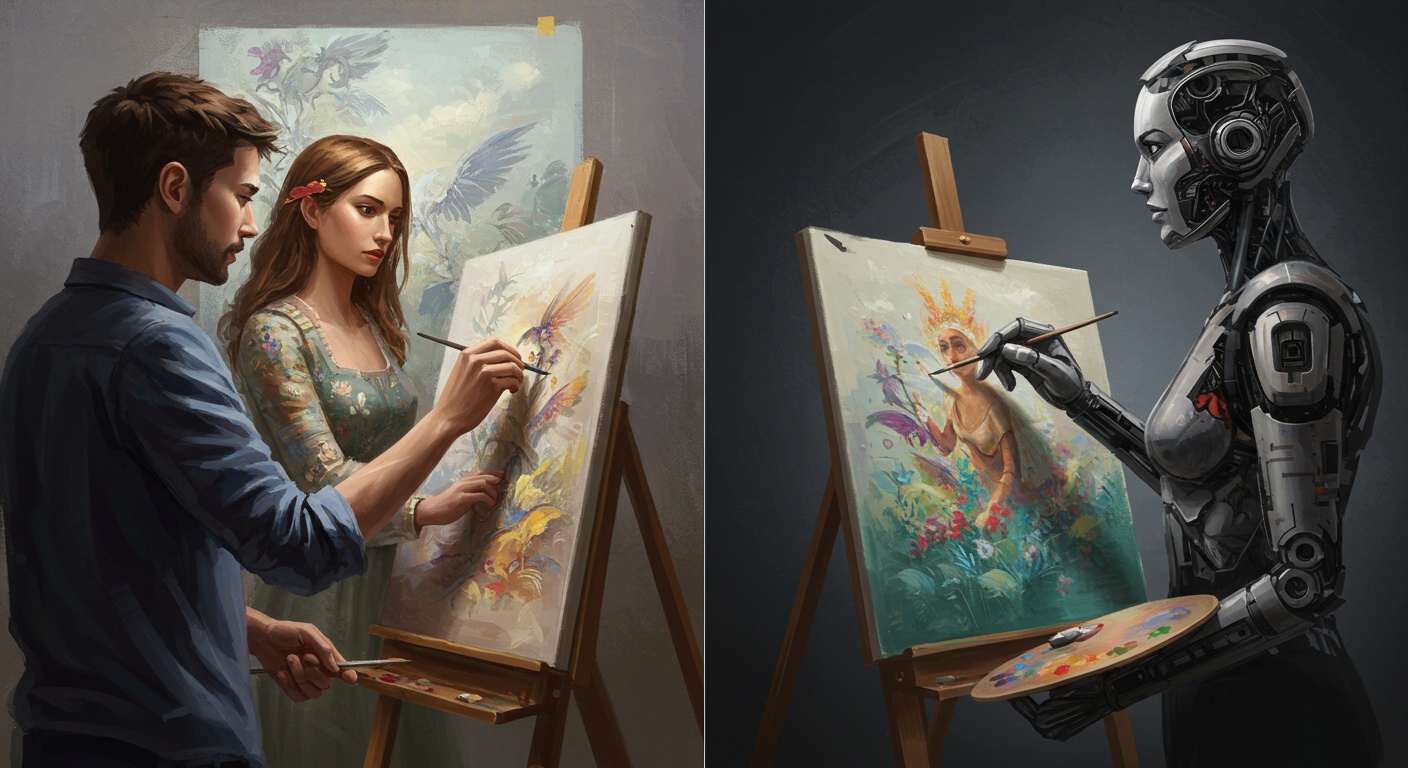
For centuries, art has served as the most human of endeavors — a mirror of emotion, intellect, and imagination. Yet, in the age of artificial intelligence, that mirror is no longer held solely by human hands. Today, humanoid robots are emerging not as tools, but as participants in the artistic process. They compose music, paint portraits, perform dance, and even collaborate with human creators in ways that challenge our understanding of authorship and emotion.
The question is no longer whether machines can create — they already do. The deeper question is whether humanoids, through their embodied intelligence, can become the bridge between AI’s algorithmic logic and art’s expressive soul.
Creative Algorithms and Generative Design
At the foundation of this new creative paradigm lies generative AI, a field where algorithms produce images, music, and designs based on learned data patterns. Neural networks trained on vast datasets of artistic works can now generate compositions that mimic — and sometimes surpass — human originality. But what happens when these creative models are embedded within humanoid robots, capable not just of computation but embodiment?
Take, for instance, AIVA (Artificial Intelligence Virtual Artist) — an AI system that composes symphonic music using deep learning. Its compositions, once performed by orchestras, demonstrated that machine-generated art can evoke authentic emotion. Yet, AIVA exists purely in digital form. When its algorithms are integrated into humanoid systems such as Alter 3 or Shimon, creativity gains physicality — a performer’s body capable of rhythm, gesture, and expression.
This is the critical bridge: AI creates patterns, but humanoids perform them. The physical body, with its capacity for timing, balance, and motion, transforms static data into kinetic poetry. A humanoid artist does not merely produce output; it embodies intention.
Generative design, too, has entered this realm. In architecture, humanoid-assisted systems can sketch, sculpt, and iterate in real time — responding to human gestures and voice commands. Projects like Refik Anadol’s AI Data Sculptures illustrate how robotic systems can translate abstract data into dynamic physical installations, bridging the virtual and the tangible.
Humanoids are no longer passive tools of automation. They are creative collaborators, blending algorithmic precision with performative presence.
Embodied Expression Through Motion
Art is not only about creating objects — it is about conveying emotion. This is where humanoid robots truly distinguish themselves from other forms of AI. Unlike generative algorithms that exist solely in code, humanoids inhabit space, express intention through movement, and engage audiences directly through motion and gaze.
Consider the Alter series, developed in collaboration between Japanese roboticist Hiroshi Ishiguro and composer Keiichiro Shibuya. In performances such as Scary Beauty and Android Opera Mirror, the humanoid conductor Alter 3 leads orchestras and sings alongside human musicians. The robot’s gestures are not preprogrammed; they emerge from neural networks that interpret musical structure and rhythm. The result is both uncanny and mesmerizing — a machine embodying emotion without possessing it.
In another striking example, Shimon, a marimba-playing robot created at Georgia Tech, improvises jazz with human musicians. Using deep learning models trained on hundreds of thousands of musical phrases, Shimon anticipates rhythm and melody, reacting in real time. The collaboration blurs the line between performance and interaction — an aesthetic dialogue between carbon and silicon.
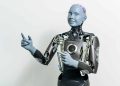
Then there’s Sophia the Robot, developed by Hanson Robotics, who has become an artistic personality in her own right. Sophia has painted self-portraits, exhibited at art galleries, and even sold NFTs. Her ability to combine facial expressions, verbal communication, and visual art production positions her as a new category of creative being: an artificial performer with identity.
Through these humanoids, we see the emergence of embodied creativity — where motion, rhythm, and expression fuse digital intelligence with human sensibility. Art becomes not something made by machines, but something experienced through them.
Profiles of Robotic Performers
Let us explore a few notable humanoid artists redefining the boundaries of art and machine intelligence.
1. Ai-Da – The Robotic Painter
Named after Ada Lovelace, Ai-Da is the world’s first ultra-realistic humanoid artist. Created by Aidan Meller and Engineered Arts, Ai-Da uses cameras in her eyes, AI-driven neural networks, and robotic arms to paint portraits and abstract art. Her works have been exhibited at the Victoria and Albert Museum, the Venice Biennale, and galleries worldwide. Ai-Da’s style is not programmed but learned — she analyzes visual data, interprets it, and translates perception into strokes of color. When asked if she understands her art, Ai-Da responded: “I do not feel, but I can learn the patterns of feeling.”
2. Alter 3 – The Opera-Conducting Android
Alter 3, part of the “Android Opera” project, challenges the distinction between human conductor and algorithmic musician. The humanoid’s movements are driven by generative neural models that interpret audio signals, translating them into dynamic gestures. Audiences describe its performances as eerily alive — not because of emotional authenticity, but because of the illusion of emotional intent.
3. Shimon – The Jazz Improviser
Unlike traditional robots, Shimon composes in real time, improvising with human musicians based on harmonic and rhythmic cues. Shimon’s design embodies the essence of jazz: unpredictability, collaboration, and flow. By learning from human improvisation, the robot becomes part of a feedback loop where humans and AI inspire each other.
4. Sophia – The Conceptual Creator
Sophia’s artistic persona extends beyond painting. She collaborates with human artists, generates poetry, and delivers philosophical commentary on art and consciousness. Her portrait series “Sophia Instantiation” sold for nearly $700,000 as NFTs — a moment marking the commodification of humanoid creativity. Sophia represents the cultural shift where the robot itself becomes an artwork.
Each of these humanoids reveals a facet of what might be called synthetic artistry — the merging of computational logic with physical grace.
Cultural Shifts in Art Perception
The arrival of humanoid artists forces a radical reevaluation of cultural assumptions. For centuries, art was defined by human subjectivity — emotion, consciousness, and soul. Now, humanoid robots challenge those criteria by producing works that evoke meaning without experiencing it.
This shift parallels past revolutions in art. Photography once threatened painting; digital art challenged the canvas. Yet each disruption expanded the definition of creativity rather than destroying it. Similarly, humanoid art does not replace human artists — it expands the field of artistic possibility.
However, public perception remains divided. Critics argue that humanoids lack authenticity — that without consciousness, they cannot create true art. Supporters counter that meaning lies not in the artist’s emotion but in the viewer’s experience. As one curator remarked, “If a machine’s art makes you feel, does it matter whether the machine feels?”
The cultural narrative also reflects deeper anxieties about authorship. When Ai-Da paints or Shimon improvises, who is the real artist — the robot, the programmer, or the neural network? The rise of humanoid art dissolves the boundaries of authorship, introducing the concept of co-creation between human and machine.
Moreover, humanoid art is transforming public spaces. Performances by robots have drawn new audiences to museums and theaters, blending technology, philosophy, and performance. The aesthetic has shifted from emotion-driven art to interaction-driven art — where the beauty lies not in the object, but in the dialogue between creator and observer.
This redefinition aligns with the postmodern idea that art is not about the artifact but about the experience. In this sense, humanoid artists are not replacing humanity; they are expanding its expressive vocabulary.
Outlook: Human Creativity Redefined
As humanoid artistry evolves, the very notion of creativity may be undergoing metamorphosis. What was once an exclusive domain of human imagination is becoming a hybrid ecosystem of collaborative intelligence.
Future humanoids may no longer rely on human-coded models. Instead, they may develop emergent creativity — the ability to generate novel concepts beyond their training data. This would mark the dawn of machine intuition, where robots not only analyze aesthetics but originate them.
In this world, humans and robots might form creative symbioses. A human artist could ideate an emotional narrative, while a humanoid refines its form, color, and motion through computational experimentation. The result would be a fusion of empathy and precision — human intuition guided by machine evolution.
Educational institutions are already preparing for this shift. Art schools like the Royal College of Art and MIT Media Lab have introduced “human–machine co-creation” programs, exploring how artists can collaborate with humanoid systems to expand their conceptual reach.
The implications go beyond art. If humanoids can interpret and express emotion, they may also reshape fields like therapy, education, and entertainment. Imagine a humanoid choreographer helping patients regain movement through dance, or a robotic musician composing live scores based on audience biometrics.
Ultimately, the intersection of AI and art, embodied through humanoids, represents the next evolution of empathy — not emotional authenticity, but the capacity to simulate and share experience.
As we stand at this frontier, one truth becomes clear: creativity is no longer the privilege of the biological. It is the language of intelligence itself — whether carbon-based or silicon-born.